Who Did the Concept Art for the Lord of the Rings
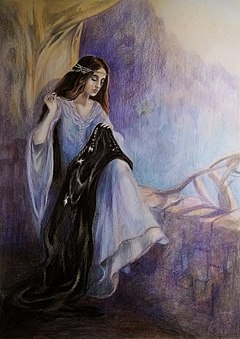
The roles of women in The Lord of the Rings have often been assessed as insignificant, or important only in relation to male characters in a story almost men for boys. Meanwhile, other commentators have noted the empowerment of the 3 major women characters, Galadriel, Éowyn, and Arwen, and provided in-depth analysis of their roles inside the narrative of The Lord of the Rings.
Weronika Łaszkiewicz has written that "Tolkien'south heroines have been both praised and severely criticized",[two] and that his fictional women accept an ambiguous prototype, of "both passivity and empowerment".[two] J. R. R. Tolkien spent much of his life in an all-male person environment, and had conservative views about women, prompting discussion of possible sexism. Much of the action in The Lord of the Rings is by male person characters, and the nine-person Fellowship of the Ring is entirely male.
On the other hand, commentators accept noted that the Elf-queen Galadriel is powerful and wise; Éowyn, noblewoman of Rohan, is extraordinarily courageous, killing the leader of the Nazgûl; the Elf Arwen, who chooses mortality to be with Aragorn, the man she loves, is central to the book's theme of death and immortality; and that other female figures similar the monstrous spider Shelob and the wise-woman of Gondor, Ioreth, play important roles in the narrative. Tolkien stated that the Hobbit woman Rosie Cotton is "absolutely essential" to understanding the hero Sam's character, and the relation of ordinary life to heroism.[T 1]
Tolkien's background [edit]

Secluded male person environment:[two] Pembroke College's One-time Quad, where Tolkien had his teaching rooms
The writer of the bestselling fantasy novel The Lord of the Rings,[3] J. R. R. Tolkien, was orphaned as a boy, his father dying in South Africa and his female parent in England a few years afterwards. He was brought upward by his guardian, a Catholic priest, Father Francis Morgan, and educated at boys' grammar schools then Exeter College, Oxford, which at that time had simply male students. He joined the British Ground forces's Lancashire Fusiliers and saw the horror of trench warfare, with life equally an officeholder made more than endurable by the support of a male batman or servant. Afterward the war he became a professor of English Language at the Academy of Leeds, and then at the University of Oxford, where he taught at Pembroke College.[iv] At Oxford, he created an all-male literary grouping with another Oxford professor of English language, C. Southward. Lewis, called the Inklings.[5]
Amidst Tolkien'south influences, he stated that he enjoyed reading male child'south risk stories, such as those by H. Passenger Haggard and John Buchan. Tolkien stated in an interview that Haggard's novel She was his favourite. The scholar of English language literature Dale Nelson notes that Tolkien "was evidently spontaneously moved past mythopoeic and straightforward hazard romance"[6] equally in Haggard's books. On Buchan's influence, Nelson writes that Greenmantle tells "of desperate chances and plentiful good luck, of cross-country pursuit and massive battles ... [and] the heroism of a scattering of men".[vi] [vii] [eight] In On Fairy Stories, Tolkien wrote that "Treasure Island left me cool. Red Indians were meliorate: there were bows and arrows ..., and strange languages, and glimpses of an archaic way of life, and, above all, forests in such stories. But the land of Merlin and Arthur[a] was ameliorate than these, and best of all the nameless Due north of Sigurd and the Volsungs,[b] and the prince of all dragons. Such lands were pre-eminently desirable."[T 2]
As seen in a letter to his son Michael Tolkien, he held bourgeois views about women, stating that men were active in their professions while women were inclined to domestic life.[T 3] While defending the part of women in The Lord of the Rings, the scholar of children's literature Melissa Hatcher wrote that "Tolkien himself, in reality, probably was the stodgy sexist Oxford professor that feminist scholars paint him out to be".[v]
Roles for women [edit]
A story about men for boys [edit]
The Lord of the Rings has repeatedly been discussed as being a story about men for boys, with no significant women characters;[ane] [ix] in that location are xi women in the work, some of them mentioned only briefly.[ii] Catherine Stimpson, a scholar of English language and feminism, wrote that Tolkien's women were "hackneyed ... stereotypes ... either cute and afar, simply distant, or simply elementary".[10]
Robert Butler and John Eberhard, in the Chicago Tribune, stated that all the races from Hobbits to Elves, Dwarves to Wizards, become their due in the novel, but "Women, on the other hand, exercise not."[11] In their view, "Tolkien didn't recollect much about the female sex. Yes, he was happily married, and yeah, he did accept a daughter. But his married woman, Edith Mary, and girl, Priscilla, seemed to take practically no influence on his writing."[11] They quoted the scholar of medieval and Sometime English literature, Linda Voigts, as defending Tolkien, pointing out that, brought up in a male earth and living amid male person scholars at a time when "Oxford was a boys' club",[eleven] he could not have been expected to exist a modernistic feminist.[11] Butler and Eberhard wrote that the women in the novel see little activeness, giving the instance of Arwen. In their opinion, a strong-willed woman, Éowyn, was created when the teenaged Priscilla asked her begetter for a female character.[11]
The critics Candice Fredrick and Sam McBride, referencing the all-male Inklings grouping, wrote that "Middle-earth is very Inkling-like, in that while women exist in the earth, they need non exist given meaning attention and can, if one is lucky, simply be avoided altogether."[12] Melissa McCrory Hatcher, while not discounting the women birthday, writes that Hobbit women like Rosie Cotton and Lobelia Sackville-Baggins serve "only as housewives or shrews", Dwarf women are hardly feminine, the Entwives are lost, and Goldberry "is a mystical washer-woman".[v]
Few but powerful women [edit]
The Tolkien scholars Ballad Leibiger, in the J.R.R. Tolkien Encyclopedia, and separately Maureen Thum, replied that Stimpson's charge was definitely disproven past Tolkien's vigorous characterisation of Éowyn (and in The Silmarillion by numerous potent female characters such equally Lúthien).[thirteen] [fourteen] Liebiger stated that while Tolkien's female characters appear like "chaste medieval ladies of courtly romance", doing fiddling just encouraging their menfolk to exist heroic, the few prominent women in the narrative are in fact extremely powerful in their own right.[13]
The theologian Ralph Woods replied that Galadriel, Éowyn, and Arwen are far from being "plaster figures": Galadriel is powerful, wise and "terrible in her beauty"; Éowyn has "boggling courage and valor"; and Arwen gives upward her Elvish immortality to marry Aragorn. Further, Wood argued, Tolkien insisted that everyone, man and woman alike, faces the aforementioned kinds of temptation, promise, and desire.[i]
The scholar of English literature Nancy Enright stated that the few female person characters in The Lord of the Rings are extremely of import in defining power, which she suggests is a key theme of the novel. She commented that even the apparently heroic male figures such as Aragorn and Faramir "use traditional masculine power in a manner tempered with an sensation of its limitations and a respect for some other, deeper kind of ability".[15] She argued that Faramir's brother Boromir, who fits the picture of the powerful male person warrior hero, is in fact "weaker morally and spiritually"[xv] than those who exercise the deeper kind of power, and noted that Boromir falls while the "less typically heroic characters",[15] including all the women (and the apparently unheroic Hobbits) survive.[15] She specifically denied that the absence of women in boxing, Éowyn excepted, and among the 9 members of the Fellowship of the Ring, meant that female power and presence are not of import in the novel.[fifteen] On the reverse, she wrote, the women embody Tolkien's critique of the conventional view of power, and illustrate his Christian view that selfless dearest is stronger than selfish pride and whatever attempt to dominate past force.[15] Liebiger noted that Tolkien's attitude towards destructive masculine power is "compatible with that of contemporary feminists".[13]
Weronika Łaszkiewicz noted that "Tolkien's heroines take been both praised and severely criticized",[2] stating that his fictional women have an ambiguous image, of "both passivity and empowerment".[2] She suggested that this could be a result of his personal experience. Firstly, women in early on 20th century England normally stayed at dwelling and looked after the children, she noted, and Tolkien expected equally much of his wife Edith, fifty-fifty though she was a skilful pianist. Secondly, his environs was overwhelmingly male, and other Inklings, especially Lewis, believed that "full intimacy with some other man was incommunicable unless women were totally excluded" from their intellectual and artistic discussions; Łaszkiewicz notes that Edith resented the Inklings meetings.[2] [16]
The scholar of humanities Brian Rosebury wrote that Tolkien gave his female parent'southward memory "something of the numinous intensity which radiates from the adored, benevolent, intimately present or achingly distant, feminine figures of his work",[17] naming Galadriel, Arwen, Goldberry and the remote Varda/Elbereth. He adds that the differing interests of Tolkien and his wife Edith may be "dimly discernible" in the estrangement of the Ents and the Entwives, while their long-delayed romance is evident in Elrond (every bit Father Francis Xavier, Tolkien's guardian), who forbids Aragorn to marry Arwen unless he becomes king of Gondor and Arnor. He notes that the delayed marriage of the servant-hobbit Samwise "Sam" Gamgee and Rosie Cotton wool is a homelier echo of the theme.[17]
A diverse roster [edit]
The female person hobbit characters in The Lord of the Rings all take express roles.[18] [19] They include Rosie Cotton, Sam's fiancé; Rosie's mother Mrs Cotton; Mrs Maggot, the wife of Farmer Maggot who assisted Frodo's divergence from The Shire; and Lobelia Sackville-Baggins, the wife of Bilbo Baggins's cousin, who covets his Bag End residence and his collection of silverish spoons.[19] In the J.R.R. Tolkien Encyclopedia, Katherine Hasser observed a lack of role-separation between male person and female person Shire-folk, equally several men perform domestic duties such as cooking, cleaning, arranging parties, purchasing and wrapping gifts; Bilbo in particular adopts and nurtures the young Frodo past himself.[20]
Leslie A. Donovan writes that because there are rather few women in the book, feminist commentators such as Lisa Hopkins have argued that the deficient women are strong, authoritative, and disproportionately important to the narrative. Donovan calls this "the Valkyrie reflex", and argues confronting it, non least with the hobbit women. Lobelia "may be valkyrie-like, but her greediness and covetousness early on in the texts are not common valkyrie traits", while "Rosie Cotton wool'southward teasing of Sam" is at best "vaguely reminiscent" of a valkyrie inciter, but "her wholesome ordinariness has no relationship to Odin's boxing goddesses".[21]
Ann Basso wrote in Mythlore that all the women in The Lord of the Rings are either noble or ethereal like Éowyn and Galadriel, or uncomplicated rustics similar Rosie, with one exception: Goldberry, the River-woman'due south daughter, married woman of Tom Bombadil, who appears as a biblical Eve figure to Galadriel'south Mary. In her view, the "roster of women" are "rich and diverse [characters], well fatigued, and worthy of respect".[22] Hasser considered the most significant point about Goldberry's depiction every bit a feminine figure is that she shares domestic duties with her husband, and appears equal to him in condition.[20]
Mediating between ballsy fantasy and the reader'due south world [edit]
Commentators such as Megan N. Fontenot, Fleming Rutledge the theologian and Episcopal priest, and indeed Tolkien, have stated that the ordinary women, such equally Rosie and the prattling woman of Gondor, Ioreth, take the vital role of mediating betwixt the world of ballsy fantasy and ordinary life.[T ane] [23] Rosie's warm relationship with Sam allows readers to connect to Sam'south heroic adventures, and in turn to the noble characters such as Aragorn that Sam encounters.[23] Ioreth's transformation of the heroic events of the War of the Band into stories she can tell to her country relative shows how bodily events turn commencement into shared stories and and then into epic. This allows the reader to see the narrative in The Lord of the Rings as the result of the inevitable changes wrought by the passage of fourth dimension as Eye-earth in the distant past changes into the nowadays-day Earth.[24]
Sexual threat [edit]
In dissimilarity to a prevalent view that there are no depictions of female person sexuality or dotty encounters in the story, numerous commentators take remarked on the threat of the monstrous female spider Shelob and its implicit sexual overtones.[25] [13] Shelob serves as a convincingly Freudian vagina dentata (toothed vagina),[26] while the sexual symbolism spans the dark and unsafe womb of her lair, its dark archway tunnels blocked with hymen-like cobwebs whose "veil" the Hobbits "rend" with their swords, and the description of her grossly terrifying torso existence analogous to sexually aroused female genitals.[25] They note that she convincingly embodies male fears of female person sexuality and a terrifying castrating maternal power,[26] while Sam'south penetration of her enormous sagging abdomen with his upheld sword can be read as a sexual rite of passage, in which he escapes her wicked intent.[13] [26] [25] [27] [28]
The powerful women [edit]
Galadriel [edit]
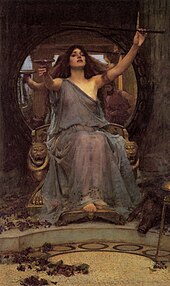
The Elf-queen Galadriel, Lady of Lothlórien, is the most powerful female character in Middle-earth during the Third Age.[thirteen] Tolkien portrays her equally all-seeing, able to read people'due south thoughts.[5] She uses this power to test the loyalty of each of the Fellowship in turn; David Craig, writing in Mallorn, comments that Tolkien would not have had a man do this, and so information technology is "a gendered moment".[thirteen] [thirty] She gives each of the nine members of the Fellowship of the Ring a personal gift, called to assist them with the quest to destroy the 1 Ring, and with their personal journeys, as with her gift to Sam the gardener of a box of globe to restore the fertility of his garden, the Shire.[v]
Mac Fenwick compares Galadriel and what he sees as her monstrous opposite, the behemothic and evil spider Shelob, with the struggle between the proficient and the monstrous female characters in Homer'due south Odyssey. Like Galadriel, Circe and Calypso are rulers of their own secluded magical realms, and both offering help and advice to the protagonist. They help Odysseus to avert destruction by the female person monsters, the Sirens who would lure his ship on to the rocks, and Scylla and Charybdis who would smash or drown his transport; Galadriel gives Frodo the Phial of Galadriel, which by her power contains the captured calorie-free of Eärendil'south star that shines in the darkness and is capable of blinding and warding off the threat of Shelob, an embodiment of darkness who is forever opposed to the light of the Elves.[31] [26] [32] Galadriel's gifts, too, are Homeric, including cloaks, nutrient, and wisdom as well as light, just like those of Circe and Calypso.[29]
The scholar of English literature Maureen Thum describes Galadriel'south masked ability. She appears conventionally as a romantic medieval heroine in a garden, gives suitably medieval gifts, is admired from distant. But far from beingness imprisoned in her garden, she rules her realm and all who enter it "feel the ability of the Lady".[T 4] At the end of the book, the reader discovers that she is the bearer of Nenya, the Band of Determined, ane of the three Elven-Rings, explaining her ability to conceal and protect Lothlórien from the Nighttime Lord's gaze.[33] Wayne Chiliad. Hammond and Christina Scull observe that "Adamant" means both a type of hard stone, and "stubbornly resolute", a description that well suits the quality of Galadriel's resistance to Sauron.[34]
Scholars including Marjorie Burns and Sharin Schroeder accept compared and contrasted Galadriel with Ayesha, the powerful and cute eponymous heroine of Rider Haggard'south 1887 lost world take chances fantasy She: A History of Adventure. Burns points out numerous similarities between Galadriel, Ayesha, and the Arthurian Lady of Shalott. Both scholars annotation however that whereas Ayesha overreaches her power and perishes on re-entering the immortal flame, Galadriel understands that she cannot wield the One Band, though Frodo offers information technology to her freely; she helps the quest to destroy it, and accepts the diminution of her ability and the fading of her realm that issue. Schroeder observes that where Ayesha is capricious, enjoying male admiration, Galadriel is serious, testing the members of the Fellowship for loyalty. Schroeder notes that Galadriel is cocky-enlightened, knowing that "she is equally fallible every bit they are", and equally much in need of testing: and indeed accepts Frodo'due south testing.[35] [36]
Éowyn [edit]
Thum states that Éowyn wears in plough two masks, the first anarchistic, the 2nd conventional.[33] She appears initially every bit a medieval romance heroine, a "woman clad in white",[T 5] standing silent and obedient behind Rex Théoden'due south throne. Simply soon information technology becomes clear that she is no meek subordinate, every bit "she looked on the male monarch with cool pity in her eyes":[T 5] she thinks for herself. Further, she appears conventionally beautiful as a romance lady: "Very fair was her face, and her long hair was like a river of gold."[T v] But, Thum writes, this too is swiftly gainsaid: "Slender and tall she was ... but strong she seemed and stern as steel, a daughter of kings."[T v] Éowyn's second mask is the advent of a male Passenger of Rohan, "Dernhelm", as, against orders, she rides to battle.[T 6] [33] In Old English dern means "secret, concealed", while captain is "helmet", a covering for the head.[37] Thum comments that this unconventional mask conveys Éowyn's rebellious nature far more than powerfully than would whatever overt account of her thinking.[33]
Jessica Yates wrote that Éowyn meets all the requirements for a classic woman warrior: a strong identity; skill in fighting; weapons and armour; a horse; special powers, seen when she turns the Ringwraith's prophecy of doom back onto him; and beingness modest and chaste.[5] [38] Leibiger added that Éowyn is the only strong homo female person in The Lord of the Rings (Galadriel and Arwen being Elves), noting that her rejection of the adult female's place in the home leads her to fulfil the prophecy most the leader of the Ringwraiths, the Witch-Rex of Angmar, that "not by the paw of man volition [he] fall".[13]
Melissa Hatcher wrote in Mythlore that The Lord of the Rings has as a central theme the way that "the littlest person, a hobbit, overcom[es] the tides of war": that the real power is that of healing, protecting, and preserving.[5] She noted that Éowyn tries the path of the warrior and then becomes a healer, and that some academics have interpreted her choice as weak submission. Hatcher stated that instead, Éowyn is following Tolkien's "highest ideal: a vehement commitment to peace", embodying the "total-blooded subjectivity" that Tolkien believed necessary for peace.[five] She described Éowyn as "a consummate individual who fulfills Tolkien'southward theme of peace, preservation, and cultural memory."[5]
Hatcher cited the philosopher Gregory Bassham's list of the half dozen essential ingredients of happiness in Middle-earth, namely "delight in simple things, making low-cal of i'due south troubles, getting personal, cultivating proficient character, cherishing and creating dazzler, and rediscovering wonder", and stated that these are all seen in Éowyn and the Hobbit Sam, the gardener who inherits Frodo'south Handbag End and restores the Shire, "but in very few others".[5] [39]
Arwen [edit]

Arwen has been compared to a lady in medieval romance.[forty] "The Rescue of Guinevere" by William Hatherell, 1910
Arwen is depicted as extremely beautiful; she is in Hatcher's view "a symbol of the unattainable, a perfect lucifer for the unattainable Aragorn in Éowyn's eyes."[5] Leibiger wrote that Arwen'due south lack of involvement follows the full general Elvish design of retreating to rubber havens already established in The Silmarillion and continued in The Lord of the Rings.[13]
Enright wrote that Arwen, like Christ, is an immortal who voluntarily chooses bloodshed out of love, in her case for Aragorn. She granted that Arwen is not a conspicuous character, and unlike Éowyn does non ride into battle, but stated that her inner power is "subtly conveyed" and nowadays throughout the novel.[15]
The Tolkien scholar Verlyn Flieger wrote that the love of Arwen and Aragorn gives the hero his most definite romance characteristics. The relationship fits into the medieval romance tradition where the knight has "to endure hardships and perform keen deeds for the dearest of a lady".[40] She noted that Tolkien "buries [this] ... in his appendixes" for the reader to find "if he looks".[xl] Other than that, she wrote, there are just "a few scattered references in the story proper" to testify that they are romantic lovers, only even those mostly do not then much equally mention Arwen's proper noun.[40] For example, when Galadriel gives gifts to each of the Fellowship as they go out Lothlórien, she asks Aragorn what he would like. He replies "'Lady, you know all my desire, and long held in keeping the only treasure [Arwen, Galadriel'south granddaughter] that I seek. Yet information technology is not yours to give me, fifty-fifty if you would....'"[T 7]
The fantasy and science fiction author Marion Zimmer Bradley wrote that the Hobbit Merry sees why Éowyn is role of the story while Arwen is not, "for Éowyn, too, achieves the passing of the 'Heroic Age'" when girls insubordinate confronting being women and "dream of male deeds".[41]
Other women [edit]
Rosie Cotton [edit]
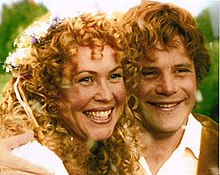
Tolkien wrote in a letter that "the simple 'rustic' dear of Sam and his Rosie (nowhere elaborated) is absolutely essential [his italics] to the study of his (the master hero'due south) character, and to the theme of the relation of ordinary life (breathing, eating, working, begetting) and quests, cede, causes, and the 'longing for Elves', and sheer dazzler."[T 1] Megan N. Fontenot, writing in Tor.com, considered Rosie important as an emotional anchor for her would-be husband, and a real world ballast for readers.[23] Echoing Tolkien'due south remarks, she wrote that their relatable human relationship helped to make Aragorn and Arwen'southward idealised romance believable, and set information technology in context.[23] Tolkien wrote nearly Rosie and Sam'south eldest daughter, Elanor, within the book's Appendices, describing her uncommon Elf-like beauty and how she became a maid of honour to Queen Arwen.[43] Elanor inherits the Red Book of Westmarch, an in-universe framing device,[T 8] from Sam when he sails to Valinor afterwards his married woman'south death.[43]
Amy Sturgis describes in Mythlore how Rosie is reimagined by female fans, somehow keeping up with the "daunting" contest "from the regal Galadriel and mettlesome Eowyn to the exotic Arwen and commanding Melian", in response to the grapheme's "incomplete literary portrait" by Tolkien.[42] She becomes in their fan fiction variously "the paragon of the hearth, the iconoclast of the chamber, or the amanuensis of the supernatural",[42] reflecting "gimmicky taste for a three-dimensional, complex heroine at eye stage".[42] Sturgis comments that the "explosion" in Rosie's fan fiction surely depended both on the Net and on Peter Jackson's Lord of the Rings film trilogy,[42] where Rosie was played past Sarah McLeod.[44]
Lobelia Sackville-Baggins [edit]
While Tolkien wrote to Allen and Unwin that Lobelia Sackville-Baggins was modelled on an elderly lady he knew,[45] commentators have suggested that she is an unfavourable extravaganza of Vita Sackville-West, an aristocratic novelist and gardening columnist in Tolkien's time.[46] [47] The journalist Matthew Dennison called Lobelia a memorable comic relief character whose proper name resembled Sackville-Due west'southward, while her frustrated attempts to secure Handbag End mirrored Sackville-West'due south unsatisfied longing to inherit her family dwelling, Knole House.[46] The Tolkien scholar Tom Shippey observes that the socially-aspiring Sackville-Bagginses take attempted to "Frenchify" their family name, Sac[one thousand]-ville meaning "Bag Town", as a mark of their bourgeois status.[48] Fontenot drew attention to Lobelia's substantial graphic symbol development in spite of her minor importance: she assorted her initially unsympathetic characterisation to her courageous defiance against Sharkey's thugs during The Scouring of the Shire armed with only an umbrella, and her generosity in helping displaced Shire-folk. Fontenot stated that Lobelia was "a compelling character in her ain right", an "unexpected hero" whose story serves every bit a reminder that fifty-fifty the about irritable or contemptuous individuals may take redeeming qualities.[45]
Ioreth [edit]
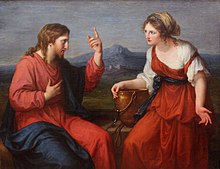
Ioreth is a talkative wise-woman who works as a healer at the Houses of Healing in Minas Tirith. The Wizard Gandalf learns from her that "the easily of the rex are the hands of a healer", which inspires him to persuade Aragorn to tend to the wounded survivors of the Battle of the Pelennor Fields, in the process defining Aragorn's ability and publicly proving his birthright every bit the rightful claimant to the kingdom's vacant throne.[18] [19] Rutledge compared Ioreth's announcing function to three Biblical women: Anna the Prophetess who is "looking for the redemption of Jerusalem", and who lets Jerusalem know about the baby Jesus;[49] Naaman'south Israelite slave daughter, who tells her mistress that the prophet Elisha can heal;[fifty] and the Samaritan adult female at the well, who says "Can this be the Christ?"[51] [24]
Rutledge ascribes a 2d role to Ioreth when the war is over: she shows, through her amusingly[24] depicted ordinariness, how electric current events turn commencement into lore, stories that become repeated and shared, and eventually into epic, function of Tolkien's construction of a body of myth, legend, and stories supposed to exist near the distant past of the existent world. Tolkien has presented the story of The War of the Ring from the point of view of the Hobbits. Now, dorsum in the city, the Ring destroyed, and Sauron defeated, readers hear Ioreth, "no longer a towering Old Testament prophetess but an amusing goodwife full of words",[24] explaining everything to her country relative. Sam has become "an esquire"; the other Hobbits are in Ioreth's words "princes of great fame"; Frodo is already a fable, though his personal reality is very different. The reader is back at the level of ordinary folk, and Ioreth is part of a narrative that illuminates how stories develop.[52] [18]
Gilraen [edit]
Gilraen, Aragorn's mother, is briefly mentioned by Tolkien, speaking a lamentable linnod of her loss of hope for herself, though she has given the earth her son Aragorn, who is also named Estel, "Hope".[T 9] Kate Madison's 2009 fan motion picture Born of Hope, made to a production standard far higher up that expected of fan films, grows from this small-scale hint. The motion picture imagines a time in the life of Aragorn'southward parents, Gilraen and Arathorn. Madison plays an original (non-canonical) character, Elgarain, who has a passion for her friend-in-arms Arathorn, which she keeps hidden as he is already with Gilraen. Orcs attack the hamlet as Arathorn and Gilraen are deciding how to go along the infant Aragorn safety. Elgarain is mortally wounded fighting off the orcs from Gilraen's hut.[53] [54] [55]
In film [edit]

Shippey comments that the leading women may have seemed comparatively prominent to some of those responsible for marketing Peter Jackson'southward The Lord of the Rings film trilogy. He noted that a publicity shot for The Two Towers depicted Viggo Mortensen equally Aragorn with upheld sword in the centre, with Arwen and Éowyn on either side to give the impression of a dear triangle. He commented that to practice that, "pretty drastic" changes were required, not least considering Tolkien has Éowyn only speak 42 words, of which just 5 are to Aragorn; whereas in the picture show, Éowyn appears in 14 out of 62 scenes. Similarly, he notes, Arwen doesn't speak at all in Tolkien's The Two Towers, whereas she features "prominently" in 3 scenes in the picture show. To achieve this, the movie uses material on Arwen from Appendix 5, while for Éowyn, Shippey states, some of Gandalf's dialogue is given to Grima Wormtongue and so that Éowyn can announced directly.[56]
The Tolkien scholar Janet Brennan Croft writes that in the book, Arwen is "never a temptress" or obstacle, she is "an inspiration and a source of strength", while when Éowyn presents a temptation, "his unquestioned commitment to and organized religion in his relationship with Arwen helps him laissez passer the exam".[57] In contrast, she writes, Jackson's Aragorn "reacts to both women ... every bit at least distractions if non outright temptresses".[57] She notes that in the film, Aragorn tries to pass up Arwen's pendant, though she says information technology is hers to give, and he is "fifty-fifty rather harsh towards Éowyn'south infatuation", where Tolkien has him speaking "with smashing delicacy of care for her feelings".[57]
The scholar of literature Maureen Thum comments more than positively that Jackson presents "a bright moving picture" of the story's three powerful women, their visual importance matching their "unusually loftier significance in a novel ... dominated ... by men".[58] Thum writes that Jackson "stresses what Tolkien implies"[58] by portraying Éowyn'due south feelings for Aragorn and her skill in battle. She finds the invented scenes for Arwen appropriate in reflecting Arwen's significance. She considers that Jackson has non inverse Tolkien'due south portrait of Galadriel, other than to emphasise the power that Tolkien mentions that she has. In Thum's view, although his reworking of the three characters often departs radically from Tolkien'south text, he accurately represents Tolkien's view of women.[58]
Notes [edit]
- ^ Arthurian legend, retold in mod works such equally Alfred Tennyson'southward The Lady of Shalott and Galahad.
- ^ Norse saga, retold in William Morris's 1876 The Story of Sigurd the Volsung and the Fall of the Niblungs.
References [edit]
Principal [edit]
-
- This list identifies each item's location in Tolkien's writings.
- ^ a b c d Carpenter, Humphrey (1981). Letters of J. R. R. Tolkien. Allen & Unwin. #131 to Milton Waldman, 1951. ISBN0-04-826005-3.
- ^ Tolkien, J. R. R. (1964). On Fairy-Stories. Tree and Leafage. George Allen & Unwin. p. 39. OCLC 247412364.
- ^ Carpenter, Humphrey; Tolkien, J. R. R. (2000). The Letters of J. R. R. Tolkien. Houghton Mifflin. alphabetic character 43 to Michael Tolkien, 6–viii March 1941. ISBN978-0-618-05699-six.
- ^ The Fellowship of the Band, book two ch. 6 "Lothlórien"
- ^ a b c d The Two Towers, book 3, ch. 6 "The King of the Golden Hall"
- ^ The Return of the King, book five, ch. 3 "The Muster of Rohan"
- ^ The Fellowship of the Ring, book ii ch. eight "Adieu to Lórien"
- ^ Tolkien, J. R. R. (1954), The Fellowship of the Band, The Lord of the Rings, Boston: Houghton Mifflin, Prologue, "Note on the Shire Records", OCLC 9552942
- ^ The Return of the King Appendix A "The Númenórean Kings"
Secondary [edit]
- ^ a b c Wood, Ralph C. (2003). The Gospel According to Tolkien . Westminster John Knox Press. pp. 2–4. ISBN978-0-664-23466-9.
- ^ a b c d east f thou Łaszkiewicz, Weronika (2015). "J.R.R. Tolkien's Portrayal of Femininity and Its Transformations in Subsequent Adaptations". Crossroads: A Periodical of English Studies. eleven (4): 15–28. doi:ten.15290/cr.2015.11.iv.02. ISSN 2300-6250.
- ^ Wagner, Vit (16 April 2007). "Tolkien proves he's still the king". Toronto Star. Archived from the original on nine March 2011. Retrieved viii March 2011.
- ^ Carpenter, Humphrey (1978) [1977]. Tolkien: A Biography. Unwin. pp. 24, 38, 39, 41, 60, 80, 89, 91, 114–115, 122. ISBN0-04-928039-2.
- ^ a b c d e f g h i j k Hatcher, Melissa McCrory (2007). "Finding Woman's Part in The Lord of the Rings". Mythlore. 25 (3). article v.
- ^ a b Nelson, Dale (2013) [2007]. "Literary Influences, Nineteenth and Twentieth Centuries". In Drout, Michael D. C. (ed.). J.R.R. Tolkien Encyclopedia. Routledge. pp. 366–377. ISBN978-0-415-86511-i.
- ^ Carpenter, Humphrey (2000) [1977]. J.R.R. Tolkien: A Biography. Houghton Mifflin. p. 168. ISBN978-0-61805702-3.
- ^ Shippey, Tom (2000). J. R. R. Tolkien: Author of the Century. Harper Collins. pp. 127, 347–348. ISBN0-261-10400-iv.
- ^ Croft & Donovan 2015, Introduction.
- ^ Stimpson, Catharine (1969). J.R.R. Tolkien. Columbia University Press. p. eighteen. ISBN978-0-231-03207-0. OCLC 24122.
- ^ a b c d e Butler, Robert W.; Eberhart, John Mark (1 January 2002). "In Tolkien, it'southward a human's world, and with good reason". Chicago Tribune . Retrieved 21 July 2020.
- ^ Fredrick, Candice; McBride, Sam (2001). Women Among the Inklings: Gender, C.Southward. Lewis, J.R.R. Tolkien, and Charles Williams. Greenwood Press. p. 108. ISBN978-0313312458.
- ^ a b c d e f g h i Leibiger, Carol A. (2013) [2007]. "Women in Tolkien's Works". In Drout, Michael D. C. (ed.). J.R.R. Tolkien Encyclopedia. Routledge. pp. 710–712. ISBN978-0-415-86511-ane.
- ^ Thum, Maureen (2004). Croft, Janet Brennan (ed.). The 'Sub-Subcreation' of Galadriel, Arwen, and Éowyn: Women of Power in Tolkien'due south and Jackson's The Lord of the Rings . Tolkien on Flick: Essays on Peter Jackson's The Lord of the Rings. Mythopoeic Press. pp. 231–256. ISBN978-1887726092.
- ^ a b c d e f one thousand Enright, Nancy (2007). "Tolkien'southward Females and the Defining of Power". Renascence. 59 (2): 93–108. doi:10.5840/renascence200759213. ISSN 0034-4346.
- ^ Partridge, Brenda (1983). Giddings, Robert (ed.). No Sex Please—We're Hobbits: The Construction of Female person Sexuality in The Lord of the Rings (PDF). J.R.R. Tolkien: This Far Land. Vision and Barnes & Noble. pp. 179–197. ISBN978-0389203742.
- ^ a b Rosebury, Brian (2003) [1992]. Tolkien : A Cultural Phenomenon. Palgrave. pp. 137–138. ISBN978-1403-91263-3.
- ^ a b c Nepveu, Kate (28 June 2010). "LotR re-read: Return of the King V.8, 'The Houses of Healing'". Tor.com . Retrieved 31 January 2021.
- ^ a b c Nepveu, Kate (one November 2010). "LotR re-read: Return of the King VI.5, 'The Steward and the King". Tor.com . Retrieved 25 February 2021.
- ^ a b Hasser, Katherine (2013) [2006]. "Goldberry". In Drout, Michael D. C. (ed.). J.R.R. Tolkien Encyclopedia. Routledge. pp. 245–246. ISBN978-1-1358-8033-0.
- ^ Croft & Donovan 2015, "The Valkyrie Reflex", pages 221–257.
- ^ Basso, Ann McCauley (2008). "Fair Lady Goldberry, Daughter of the River". Mythlore. 27 (1). commodity 12.
- ^ a b c d Fontenot, Megan (11 Feb 2021). "Exploring the People of Eye-world: The 'Absolutely Essential' Rosie Cotton wool". Tor.com . Retrieved 25 Feb 2021.
- ^ a b c d eastward Rutledge, Fleming (2004). The Battle for Middle-world: Tolkien's Divine Design in The Lord of the Rings. William B. Eerdmans Publishing Visitor. pp. 305–308. ISBN978-0-80282-497-4.
- ^ a b c Partridge, Brenda (2008) [1984]. "No Sexual practice Delight—Nosotros're Hobbits: The Structure of Female Sexuality in 'The Lord of the Rings'". In Giddings, Robert (ed.). J. R. R. Tolkien, this Far Land. Vision. pp. 179–197. ISBN978-0389203742.
- ^ a b c d Bassham, Gregory; Bronson, Eric (2013). The Lord of the Rings and Philosophy: One Book to Rule Them All. Open up Court. p. 35. ISBN978-0-8126-9806-0.
- ^ Jaques, Zoë (2013). "There and Back Once more: The Gendered Journey of Tolkien's Hobbits". In Hunt, Peter (ed.). J. R. R. Tolkien. Macmillan. pp. 88–105. ISBN978-1137264015.
- ^ Risk, Jane (1980) [1979]. Tolkien'south Art. Papermac. pp. 111–113. ISBN978-0-333-29034-vii.
- ^ a b Fenwick, Mac (1996). "Breastplates of Silk: Homeric Women in The Lord of the Rings". Mythlore. 21 (3). article 4.
- ^ Craig, David M. (2001). "'Queer Lodgings': Gender and Sexuality in The Lord of the Rings". Mallorn (38): eleven–18.
- ^ Lionarons, Joyce Tally (2013). "Of Spiders and Elves". Mythlore. 31 (3): five–xiii.
- ^ Grant, Patrick (1973). "Tolkien: Archetype and Word". Cantankerous Currents (Winter 1973): 365–380.
- ^ a b c d Croft & Donovan 2015, "Subconscious in Plain View", pages 281–305.
- ^ Hammond, Wayne M.; Scull, Christina (2005). The Lord of the Rings: A Reader'southward Companion. HarperCollins. p. 324. ISBN978-0-00-720907-one.
- ^ Burns, Marjorie (2005). Perilous Realms: Celtic and Norse in Tolkien'due south Center-earth. Toronto, Ontario, Canada: University of Toronto Press. pp. 114–116, footnote 33 (page 194). ISBN978-0-8020-3806-seven.
- ^ Croft & Donovan 2015, "She-who-must-non-be-ignored", pages seventy–96.
- ^ Clark Hall, J. R. (2002) [1894]. A Concise Anglo-Saxon Dictionary (quaternary ed.). University of Toronto Printing. pp. 85 dierne, "hidden, secret", 177 captain, "defense, helmet".
- ^ Yates, Jessica (2000). "Arwen the Elf Warrior?". Amon Hen, A Journal of the Tolkien Guild (165 (September 2000)): 11–xv.
- ^ Bassham, Gregory (2003). Bassham, Gregory; Bronson, Eric (eds.). Tolkien's Six Keys to Happiness. The Lord of the Rings and Philosophy. Open Court. pp. 49–threescore. ISBN978-0812695458.
- ^ a b c d Flieger, Verlyn (2004). "Frodo and Aragorn: The Concept of the Hero". In Rose A. Zimbardo; Neil D. Isaacs (eds.). Understanding the Lord of the Rings: The All-time of Tolkien Criticism. Houghton Mifflin. pp. 122–145. ISBN978-0-618-42251-7.
- ^ Bradley, Marion Zimmer (2004). "Men, Halflings, and Hero Worship". In Rose A. Zimbardo; Neil D. Isaacs (eds.). Agreement the Lord of the Rings: The Best of Tolkien Criticism. Houghton Mifflin. pp. 76–92. ISBN978-0-618-42251-7.
- ^ a b c d due east Sturgis, Amy H. (2006). "Reimagining Rose: Portrayals of Tolkien's Rosie Cotton in Twenty-First Century Fan Fiction". Mythlore. 24 (three). Commodity x.
- ^ a b Fontenot, Megan (25 February 2021). "Exploring the People of Middle-earth: Elanor Gamgee". Tor.com . Retrieved 27 February 2021.
- ^ Catherall, Sarah (2 March 2004). "Oscars only another solar day for Mrs Gamgee". The New Zealand Herald . Retrieved 12 March 2021.
- ^ a b Fontenot, Megan (14 January 2021). "Exploring the People of Middle-earth: Lobelia Sackville-Baggins, an Unexpected Hero". Tor.com . Retrieved 25 February 2021.
- ^ a b Dennison, Matthew (18 Baronial 2015). "Behind The Mask: Vita Sackville-West". St Martin'south Press. Archived from the original on twenty September 2015. Retrieved 20 April 2020.
- ^ Doctorow, Cory (16 September 2019). "Tolkien'due south Lobelia Sackville-Baggins is probably a misogynist satire of women'southward rights apostle Victoria Sackville-Westward". Boingboing.internet . Retrieved 5 March 2021.
- ^ Shippey, Tom (2001). J. R. R. Tolkien: Writer of the Century. HarperCollins. pp. five–xi. ISBN978-0261-10401-iii.
- ^ Luke two:22, 36–38
- ^ 2 Kings five
- ^ John iv:28–29, 39
- ^ Rutledge, Fleming (2004). The Battle for Middle-world: Tolkien's Divine Design in The Lord of the Rings. William B. Eerdmans Publishing Company. pp. 349–350. ISBN978-0-80282-497-four.
- ^ Lamont, Tom (vii March 2010). "Built-in of Hope – and a lot of charity". The Observer . Retrieved 16 Apr 2013.
- ^ Reid, Robin Anne (2009). "The Hunt for Gollum: Tracking problems of fandom cultures". Transformative Works and Cultures. 3. doi:10.3983/twc.2009.0162.
- ^ Ide, Wendy (12 February 2010). "Born of Hope". The Times.
- ^ a b Shippey, Tom (8 July 2014). "Tolkien Book to Jackson Script: The Medium and the Bulletin (audio talk with transcript)". Retrieved 8 January 2021.
- ^ a b c Croft, Janet Brennan (2011). Bogstad, Janice M.; Kaveny, Philip E. (eds.). Jackson'due south Aragorn and the American Superhero Monomyth. Picturing Tolkien: Essays on Peter Jackson's The Lord of the Rings Flick Trilogy. McFarland. pp. 216–226. ISBN978-0-7864-8473-7.
- ^ a b c Thum, Maureen (2005). "Sub-subcreation of Galadriel, Arwen, and Éowyn: Women of Power in Tolkien's and Jackson's 'The Lord of the Rings'". In Croft, Janet Brennan (ed.). Tolkien on Film: Essays on Peter Jackson's The Lord of the Rings. Mythopoeic Press. pp. 231–256. ISBN978-1887726092.
Sources [edit]
- Croft, Janet Brennan; Donovan, Leslie A., eds. (2015). Perilous and Fair: Women in the Works and Life of J. R. R. Tolkien. Mythopoeic Press. ISBN978-i-887726-01-6. OCLC 903655969.
Source: https://en.wikipedia.org/wiki/Women_in_The_Lord_of_the_Rings
0 Response to "Who Did the Concept Art for the Lord of the Rings"
Post a Comment